Understanding tagline vs slogans can help you choose the right words for a brand, campaign, product, or social post. Below, you’ll find original examples plus simple tips explaining how taglines and slogans differ and when to use each one.For more insights read here:- great slogans and famous slogans.
- Top 10 Quick List
- Short & Simple Slogans
- Catchy & Fun Slogans
- Rhyming Slogans
- Professional / Business Slogans
- For Posters & Social Media
- Tagline vs Slogans: What's the Difference?
- Why the Difference Matters
- How to Use These Slogans
- 1. Use Them in Educational Content
- 2. Add Them to Social Posts
- 3. Put Them on Posters
- 4. Use Them in Marketing Exercises
- 5. Adapt Them for Creative Projects
- How to Write Your Own Tagline or Slogan
- 1. Start With One Clear Message
- 2. Keep It Short
- 3. Use Strong, Natural Words
- 4. Try a Rhythm or Rhyme
- 5. Read It Out Loud
- Do and Don't for Writing Good Slogans
- FAQs About Tagline vs Slogans
- What is the main difference between a tagline and a slogan?
- Can a business have both a tagline and slogans?
- Are taglines and slogans the same thing?
- How long should a tagline be?
- Should a slogan rhyme?
- Conclusion
Top 10 Quick List
- A tagline gives a brand a lasting voice; a slogan gives a message a moment.
- Taglines build identity; slogans build attention.
- One brand, one lasting line; one campaign, one timely line.
- Make your identity memorable, then make your message matter.
- A strong tagline stays; a smart slogan speaks to the moment.
- Taglines shape brands; slogans support ideas.
- Give your brand a voice and your message a spark.
- Long-term identity meets short-term impact.
- Your brand needs a signature; your campaign needs a clear call.
- Say who you are, then say what matters now.
Short & Simple Slogans
- Give Every Message Meaning.
- Words Build Recognition.
- Make Your Message Stick.
- Simple Words, Strong Identity.
- Say It With Purpose.
- Make Every Line Count.
- A Clear Message Wins Attention.
- Small Words, Big Recall.
- Speak Clearly. Stay Memorable.
- Your Words Shape Your Story.
These work well for websites, presentations, educational graphics, brand guides, and quick social posts.
Catchy & Fun Slogans
- Brand It. Say It. Remember It.
- One Great Line, Plenty of Impact.
- Make Words Work Harder.
- Catch Attention, Keep Meaning.
- Give Your Ideas a Memorable Voice.
- Good Words Get Noticed.
- Turn Simple Words Into Signature Moments.
- A Little Phrase Can Go a Long Way.
- Make Your Message the One They Remember.
- Words With Personality Get Remembered.
Use these playful lines for creative projects, marketing graphics, classroom activities, or social content.
Rhyming Slogans
- Brand with Care, Speak with Flair.
- Write It Bright, Make It Right.
- Short and Sweet, Hard to Beat.
- Say It Clear, Keep It Near.
- Make It Flow, Let Meaning Show.
- Pick Your Line, Make It Shine.
- Strong in Sound, Easy to Recall.
- Words That Stay, Day After Day.
- Write With Sense, Make an Impression.
- A Clever Phrase Can Set the Pace.
Rhyming lines can be useful when you want your message to sound natural and stick in someone’s memory.
Professional / Business Slogans
- Build Recognition With Every Word.
- Your Identity Deserves a Clear Voice.
- Make Your Brand Easy to Remember.
- Purpose in Every Phrase.
- A Strong Identity Starts With Clear Communication.
- Give Your Business Words That Fit.
- Create Recognition, Communicate Purpose.
- Your Message. Your Meaning. Your Voice.
- Clarity Creates Stronger Connections.
- Let Your Words Represent Your Business.
These are suitable for business presentations, marketing lessons, agency content, brand strategy discussions, and company social media.
For Posters & Social Media
- Know Your Identity. Shape Your Message.
- One Brand, Many Messages, One Clear Voice.
- Say What You Stand For.
- Make Your Message Easy to Share.
- A Memorable Line Starts a Conversation.
- Clear Words. Strong Ideas. Better Recall.
- Your Message Deserves the Right Words.
- Turn Attention Into Recognition.
- Write Less. Mean More.
- Give Every Campaign Its Own Voice.
These short lines can fit posters, Instagram graphics, LinkedIn posts, presentation slides, campaign artwork, and educational content.
Tagline vs Slogans: What’s the Difference?
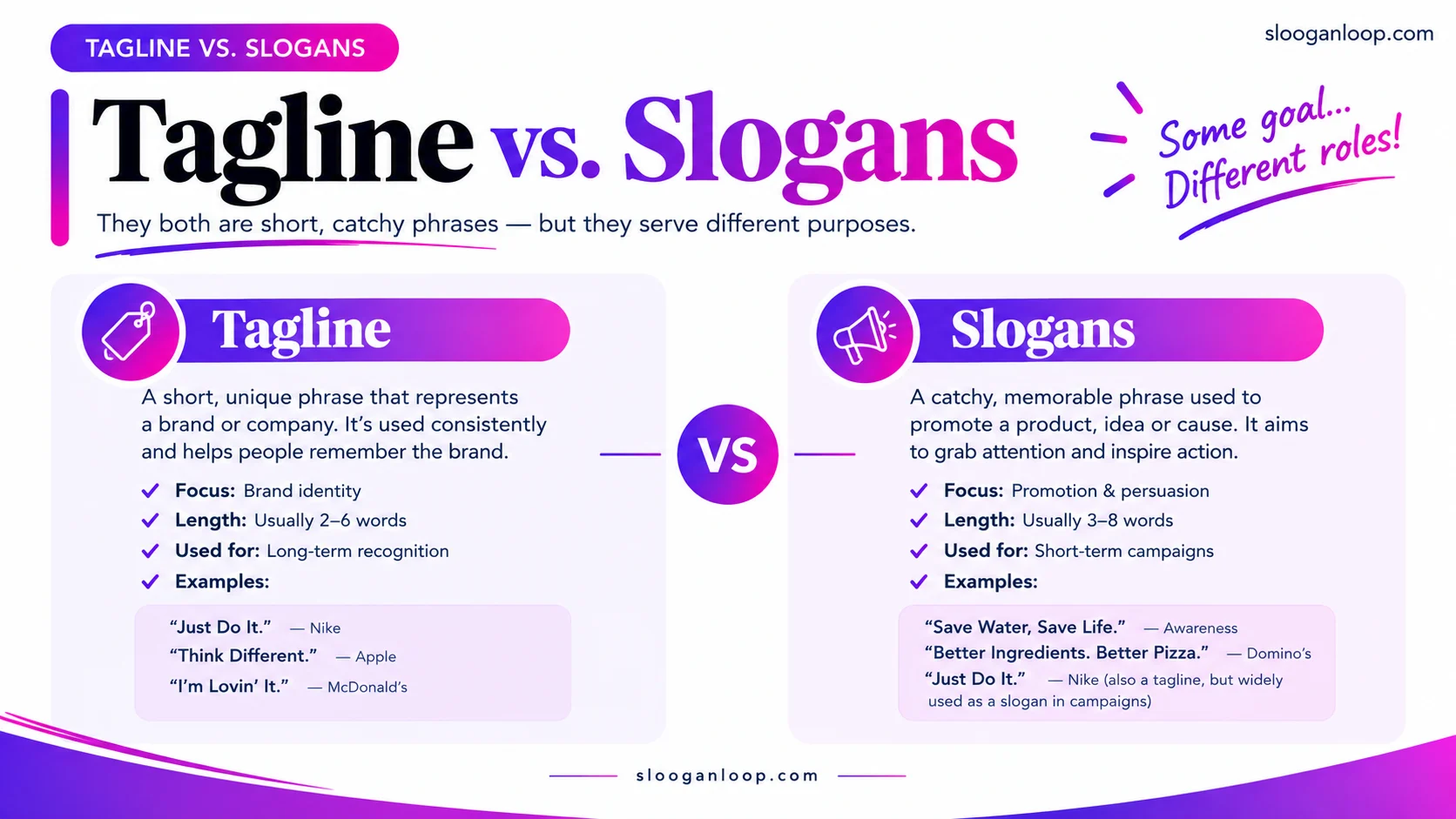
The two terms are closely related, but they usually serve different purposes.
A tagline is generally a memorable phrase connected to a brand’s identity. It can remain part of the brand’s communication for years and helps people associate a particular idea, feeling, or personality with that business.
A slogan is often created for a particular product, campaign, promotion, event, or marketing message. It may have a shorter lifespan and can change as the campaign or marketing goal changes.
For example, imagine a fictional company called BrightPath Learning.
Its long-term brand tagline could be:
Learning That Moves You Forward.
A campaign slogan for a summer course might be:
Make This Summer Your Smartest Season.
The first line represents the broader identity. The second communicates a specific campaign idea.
Why the Difference Matters
Knowing the difference helps you avoid giving every marketing message the same job.
A tagline should generally communicate something lasting about a brand. It needs to feel closely connected to the company’s personality and overall promise.
A slogan can be more flexible. It can respond to a new product, seasonal promotion, social campaign, event, or specific audience.
Think of it this way:
Tagline = lasting brand identity
Slogan = focused marketing message
There can be overlap, and people often use the words interchangeably. The important thing is understanding the purpose behind the phrase you’re creating.
How to Use These Slogans
1. Use Them in Educational Content
These examples can make a marketing lesson, presentation, or classroom discussion more interesting. Put a few lines on slides and ask readers to decide whether each one feels more like a lasting brand phrase or a campaign message.
2. Add Them to Social Posts
Short lines work especially well on Instagram graphics, LinkedIn posts, Facebook content, and other visual platforms. Keep the supporting text short so the main phrase remains easy to read.
3. Put Them on Posters
Choose a clear, bold line for posters about branding, communication, marketing, or creative writing. Large text and plenty of empty space can make a short slogan easier to notice.
4. Use Them in Marketing Exercises
Businesses and students can use these examples as starting points. Take one idea and rewrite it in several different tones, such as professional, playful, emotional, or modern.
5. Adapt Them for Creative Projects
You can turn a short line into a presentation heading, campaign concept, classroom activity, or content idea. Just make sure your final wording fits the purpose and audience.
How to Write Your Own Tagline or Slogan
1. Start With One Clear Message
Decide what you want people to remember. Trying to communicate five ideas in one short line usually makes the wording harder to remember.
2. Keep It Short
Short phrases are easier to read, repeat, share, and remember. Remove unnecessary words until the main idea remains.
3. Use Strong, Natural Words
Choose words that match the personality of the brand or campaign. A serious business may need polished language, while a playful campaign can use lighter wording.
4. Try a Rhythm or Rhyme
A natural rhythm can make a phrase more memorable. Don’t force a rhyme, though. A clear message is more important than a clever ending.
5. Read It Out Loud
Say the line several times. If it feels awkward, too long, or difficult to say, revise it. A good phrase should sound natural as well as look good on a screen.Also explore:- slogans.
Do and Don’t for Writing Good Slogans
| Do | Don’t |
|---|---|
| Keep the message clear | Pack in too many ideas |
| Use simple language | Use complicated wording |
| Match the audience | Ignore who will read it |
| Give the line personality | Make every phrase sound generic |
| Check how it sounds aloud | Focus only on how it looks |
| Make it easy to remember | Make it unnecessarily long |
FAQs About Tagline vs Slogans
What is the main difference between a tagline and a slogan?
A tagline usually represents a brand’s broader and more lasting identity. A slogan is often connected to a specific campaign, product, promotion, or message.
Can a business have both a tagline and slogans?
Yes. A business can use one consistent tagline while creating different slogans for individual campaigns, products, events, or promotions. This allows the brand to stay recognizable while keeping its marketing fresh.
Are taglines and slogans the same thing?
Not exactly, although the terms are frequently used interchangeably. Their main difference is usually their purpose and lifespan rather than their wording or format.
How long should a tagline be?
There is no fixed word count, but shorter is usually better. A concise phrase that communicates a clear brand idea is easier for people to remember.
Should a slogan rhyme?
It doesn’t have to rhyme. Rhyme can make a slogan catchy, but clarity, relevance, originality, and easy pronunciation matter more.
Conclusion
The key to tagline vs slogans is simple: a tagline usually helps express lasting brand identity, while a slogan often supports a specific message or campaign. Use these original examples as inspiration, then explore more creative slogan lists on slooganloop.com to find the right words for your next idea.